Stained Glass
Principles: Life and Death.

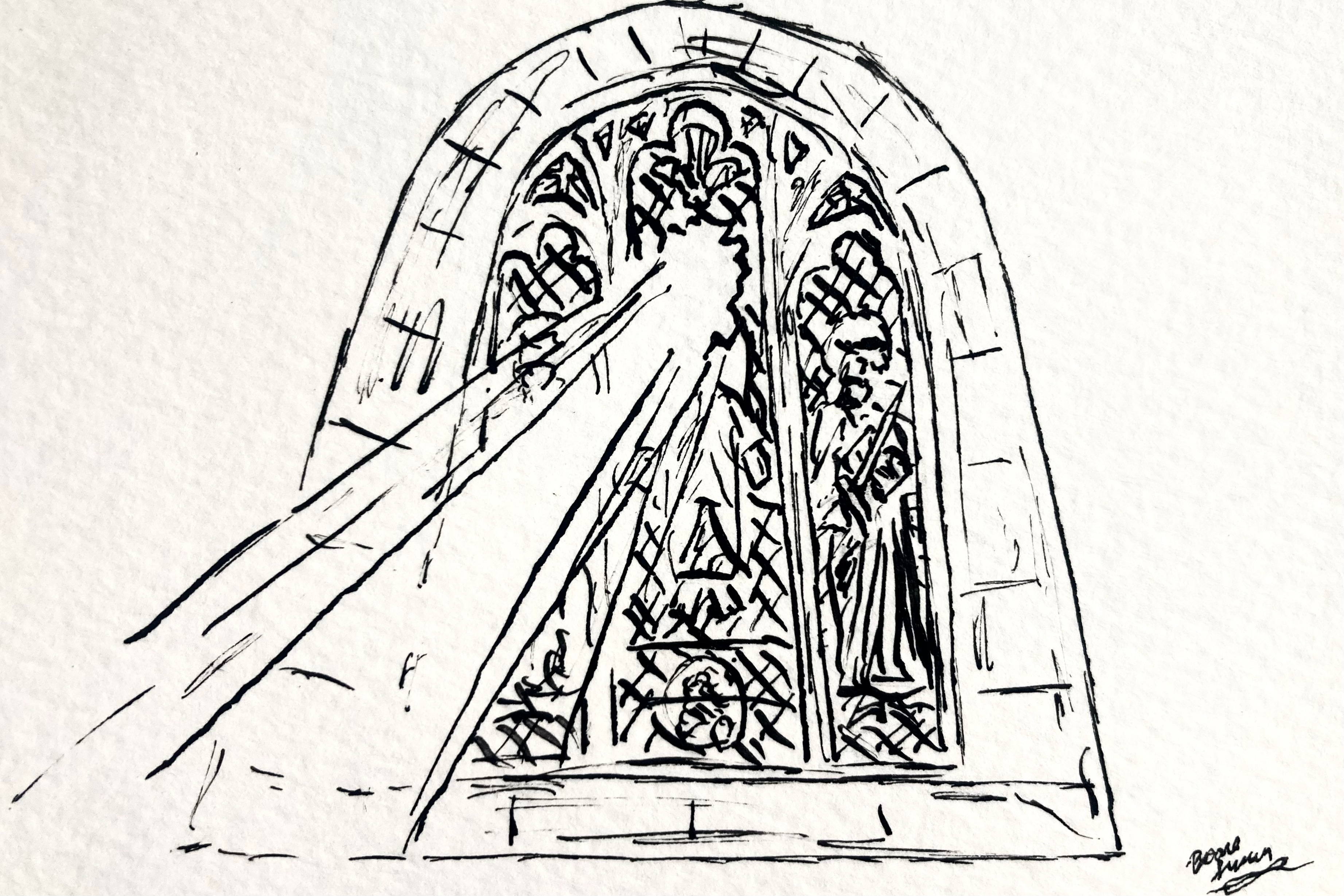
A gaunt man glares gloomily down over my shoulder.
I write this from the post-graduate library, Martyr’s Kirk (kirk is the Scottish term for church) in the shadow of stained glass. The dramatic reading room of vaulted ceiling and stone columns is the envy of the undergraduates, and it fills up fast. It is a wonderfully academic setting for students to look at their laptops.
Upon entering, the beauty first struck my eye. But like the thunder that follows lightning, the tragic scene blasted my heart with sadness. Gloom rumbled through my soul.
In 2012, the Church of Scotland sold this property to the University of St. Andrews. The church had died. The congregation dwindled into oblivion. This is not the tragedy, however. The church that occupied the building had long since lost their purpose of existence. The Church of Scotland’s primary issues today are “confessional reform,” climate change, and “retrospective apologies” to those punished for witchcraft. Homosexuality is a long-gone controversy. Their grand assemblies meet to ask the devilish question, “did God really say?” as they scour the Scriptures for places to cram in the creeds of the Prince of Darkness. In more conciliatory terms, they bend to culture. But to bend to the world is to break from God.
This land’s story is the tragedy. The other day after church, I had lunch at the home of an elderly couple. As the tea was poured after lunch, so poured out the stories. Miss M. was a child in “the city of the book” as Glasgow was called in her day for its love of the Scriptures. Every day her public school began with the singing of hymns. That Scotland is no more. Her sister, who had a career as a teacher, said that before retirement it was common for her students to have never even heard the name “Jesus.” Miss M.’s country today is “unrecognizable.”
Scotland for centuries was recognized by its godliness. In St. Andrews centuries-old buildings tell the epic of history. St. Salvador’s Chapel, directly across the street from where I sit, still bears the scars of the Reformation. Empty alcoves stand where graven images of saints once stood. The Reformers smashed them. One of the many things that sparked the Reformation were such icons of the Roman Catholic Church. The Reformers believed that God meant what he said on Mt. Sinai when He forbade the making of images. Yet, I now sit under the shadows of eerie faces labeled, David, St. Paul, and Jesus.
You will likely be revolted by the nature of iconoclasm, disgusted by the intolerant, unloving ideology that caused the Reformers to destroy “art.” You might say that revolutionary thought which tears down history is just what’s wrong with the world. How can Boone defend these acts?
I do not mean to make an argument for or against the theology of images, nor a defense of destroying them if they are indeed an affront to God. I mean to pose to you, perhaps the conviction of the Reformers is the thing we lack.
In the 1840s, the Church of Scotland began putting stained glass images back in their churches. This coincided with the artistic movement of the Gothic Revival. The Church of Scotland forsook their foundational principles to please the world. The arguments for these changes were likely the same then as ever. Some wanted to attract more people to the churches. Some were wooed by the beauty of the art. Some did not care either way. Some held beliefs but were either too weak or afraid to do anything. Then there were some who stood up.
How ever the change happened, it happened. Now, on a Sunday morning you will not find a church gathered in Martyr’s Kirk, but secular students at a secular university.
A church once recognized by its great zeal is now recognized by its great decline. The Church of Scotland lost sight of their Purpose. Was it to glorify God, or please the world? The two cannot coexist. As it says in the Scriptures,
“If anyone loves the world, the love of the Father is not in him” (1 John 2:12).
“Whoever is not with me is against me” (Matthew 12:30).
The Church of Scotland cut themselves off from their Foundational Principles. They cut themselves off from the Word. If the branch cuts itself off from the Vine, why are we surprised when the branch withers?
Forsaking principles to fornicate with the world brings death. This is true not only of a church, but of a person, a nation, and a people. Only principles can bring purpose, conviction, and life. All other aims make living a mere existence.
Bold living is the only living.
A Deplorable.